
The year 2010 was a tumultuous one for micro-finance institutions (MFIs) in India.

Andhra Pradesh Governor ESL Narasimhan met Congress president Sonia Gandhi on Friday evening to reportedly discuss the administrative and political situation in the state.The two discussed the expansion of the state cabinet, the ordinance on micro-finance institutions, trimming the administration and preparing for political developments after the Justice Sri Krishna Committee submits its report on the creation of Telangana state.

Investors are shying away from securitised loans of micro-finance institutions (MFIs), as the ordinance issued by the Andhra Pradesh government has slowed recoveries, creating uncertainty around the underlying portfolio.

This is the first Budget in my memory of Budgets over the last half a century which has embraced upfront, enthusiastically and emphatically, technology, modernity and fiscal sobriety, notes Shreekant Sambrani.

MFI tactics have even prompted Andhra Pradesh Cabinet to approve an ordinance to rein them in.

'We need to be far more careful given the fact that while this is group lending, it's essentially unsecured.'
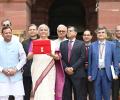
With the reality of coalition politics staring the BJP in its face, this was inevitable, points out Ramesh Menon.

he feels they are prone to misuse by borrowers, including farmers, and suggested a rate ceiling for loans by micro finance lenders.

Race for Asia's No. 1 MFI spot: Bandhan now closes in on Grameen Bank

The World Bank has approved loans totalling $1.75 billion (about Rs 13,834.54 crore) to fund India's PM Ayushman Bharat scheme and private investment to boost the economic growth. Of the total loan, $1 billion will go towards the health sector, while the rest $750 million will be in the form of development policy loan (DPL) to fill the financing gaps through private sector investment in the economy. The World Bank Board of Executive Directors approved two complementary loans of $500 million each to support and enhance India's health sector.

Ayan Pramanik reports on former Infosys CFO V Balakrishnan's fintech firm, which aims to make borrowing easy for small firms and individuals.

Every political party loves to use the bait of loan waiver to woo the electorate. If their hearts bleed for the poor, they can always use the party funds to pay off the lenders, suggests Tamal Bandyopadhyay.
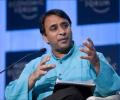
In 2012, Akula quit as chairman of Bharat Financial Inclusion (formerly SKS Microfinance), which he'd founded and led to a successful initial public offering
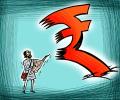
The origin of the challenge is the so-called "fresh start" process. Many in the MFI industry apprehend that such a law in India will encourage small unsecured borrowers to default and destroy the credit culture. So, while'Fresh start' is a welcome step as it will free up the debtors from the archaic laws of the colonial era, debtors need handholding and counselling to prevent any misuse, says Tamal Bandyopadhyay.

Jaitley's team presents a quintessential mix of foreign-educated, intellectual technocrats and seasoned bureaucrats

Indian economy about to take-off

Once these banks start showing losses, they will not be able to pay dividends to the government nor pay taxes, which will further aggravate the situation for the government as its return on investment as an investor would be very negligible for the next few years, says M V Subramanian.

India Inc has few leaders who are likely to grab headlines in 2015.

'Let us not say that Modi has not delivered on anything; he has delivered something and in parts substantially, but he has to also deliver on a large number of his electoral promises.'

President Pranab Mukherjee on Monday addressed the first joint sitting of Parliament as mandatorily required under the Constitution after the general elections. The address is the political, economic and foreign policy road map of the Narendra Modi government and covers virtually all crucial areas.
